
 Wildlife
of Japan
Baikal Teal
Ducks, Geese & Grebes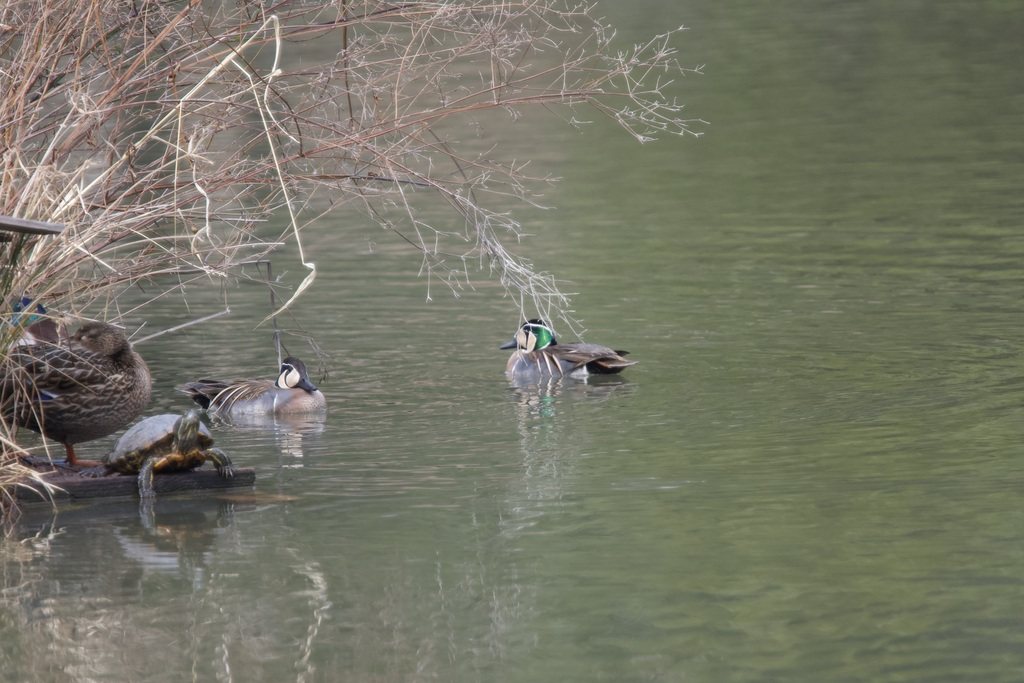
Photo: (c) Jiro Iguchi, some rights reserved (CC BY) · CC-BY (May be cropped or resized)
Sibirionetta formosa
Rare visitor: recorded only occasionally in this country
Basic stats
Diet
Seeds, grain and aquatic invertebrates
Habitat
Marshes, lakes, rivers and flooded fields
Size
39–43cm
The Baikal Teal is a small East Asian dabbling duck with an exceptionally patterned breeding male. His head shows green, cream, black and buff panels divided by crisp dark lines, while the body is finely grey and chestnut. Females are mottled brown with a pale spot at the bill base and a dark eye line, resembling female Eurasian Teal but with a more strongly marked face (Wikipedia, general species account).
Baikal Teal breed in wet northern forests and tundra-edge wetlands, then migrate south to lakes, rivers, marshes and flooded farmland. They dabble for seeds, grain and aquatic invertebrates, often feeding at night. Wintering birds can form enormous, densely packed flocks. Japan supports regular passage and wintering groups, especially in productive lowland wetlands and rice-growing landscapes each year (Wikipedia, general species account).
Quick answers
- What does the Baikal Teal eat?
- Seeds, grain and aquatic invertebrates
- What habitat does the Baikal Teal live in?
- Marshes, lakes, rivers and flooded fields
- How big is the Baikal Teal?
- 39–43cm
In Japan
GBIF holds 48 records of the Baikal Teal from 5 protected areas in Japan, dated 1991 to 2024. Most come from Biwako Quasi-National Park and Abashiri Quasi National Park.
Where it has been recorded
- Biwako Quasi-National Park 34 records, latest 2024
- Abashiri Quasi National Park 4 records, latest 2023
- Onuma Quasi-National Park 4 records, latest 2019
- Higashiyoka-higata 3 records, latest 2024
- Lake Tofutsu 3 records, latest 2022
Seen on trips we host
- Winter Birding on Ice (Charley Hesse) Tropical Birding, 2012
- Winter Birding on Ice (Charley Hesse) Tropical Birding, 2014
- Winter Birding on Ice (Charley Hesse) Tropical Birding, 2018
- Winter Birding on Ice (Charley Hesse) Tropical Birding, 2020
Also in our other guides: Korea.
Records: GBIF occurrence data matched to park boundaries (© OpenStreetMap contributors, ODbL; Wikidata). Counts show recording effort, not how common the species is.