 Wildlife
of Japan
Tundra Swan
Ducks, Geese & Grebes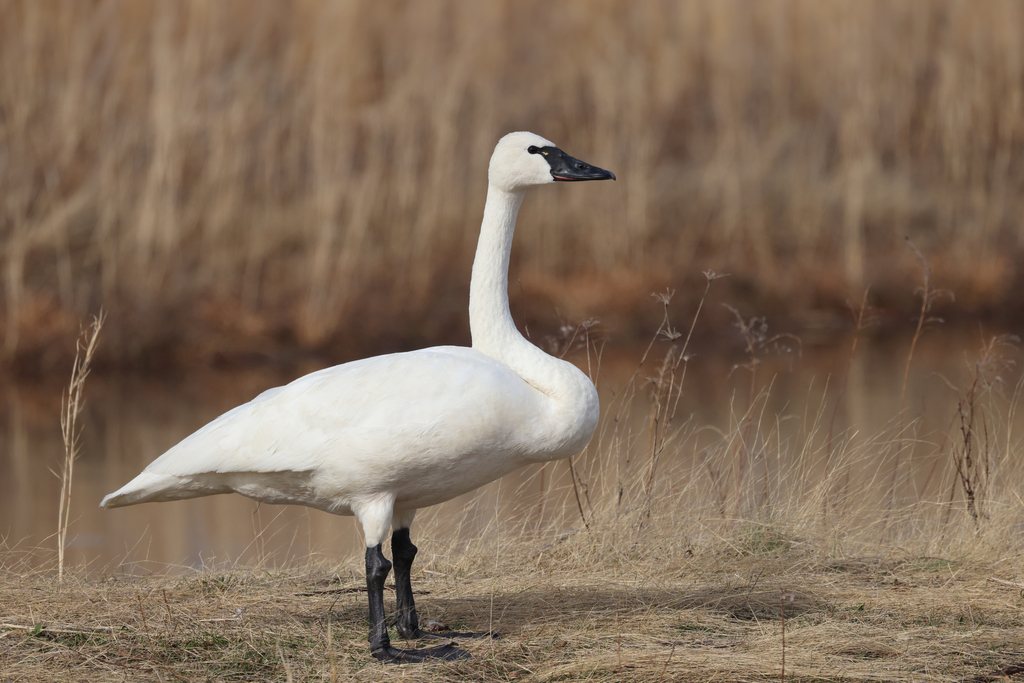
Photo: no rights reserved · CC0
Cygnus columbianus
Rare visitor: recorded only occasionally in this country
Basic stats
Diet
Aquatic vegetation, roots and grain
Habitat
Tundra pools, lakes, estuaries and farmland
Size
115–150cm
The Tundra Swan is a large white swan, smaller and shorter-necked than the Whooper Swan. The Eurasian Bewick's form has a black bill with a variable yellow patch near the base, usually more rounded and less extensive than on a Whooper Swan. Juveniles are greyish with pink-toned bills. Individual yellow bill patterns can be distinctive enough for researchers to recognize particular birds (Wikipedia, general species account).
Tundra Swans breed beside shallow pools and lakes across Arctic tundra, building mound nests on low dry ground. They feed on aquatic plants, roots and tubers by dipping and upending, and use waste grain and grasses on migration and wintering grounds. Strongly migratory family groups travel to temperate wetlands; Bewick's Swans winter locally in Japan on lakes, estuaries and surrounding farmland (Wikipedia, general species account).
Quick answers
- What does the Tundra Swan eat?
- Aquatic vegetation, roots and grain
- What habitat does the Tundra Swan live in?
- Tundra pools, lakes, estuaries and farmland
- How big is the Tundra Swan?
- 115–150cm
In Japan
GBIF holds 139 records of the Tundra Swan from 8 protected areas in Japan, dated 1988 to 2024. Most come from Lake Utonai and Lake Kutcharo.
Where it has been recorded
- Lake Utonai 41 records, latest 2024
- Lake Kutcharo 23 records, latest 2024
- Biwako Quasi-National Park 19 records, latest 2024
- Abashiri Quasi National Park 18 records, latest 2024
- Lake Tofutsu 14 records, latest 2024
- Nemuro Peninsula & Lake Furen 11 records, latest 2024
- Fuji-Hakone-Izu National Park 7 records, latest 2023
- Onuma Quasi-National Park 6 records, latest 2020
Covered in our place guides: Nemuro Peninsula & Lake Furen.
Also in our other guides: Korea.
Records: GBIF occurrence data matched to park boundaries (© OpenStreetMap contributors, ODbL; Wikidata). Counts show recording effort, not how common the species is.