 Wildlife
of Japan
Whooper Swan
Ducks, Geese & Grebes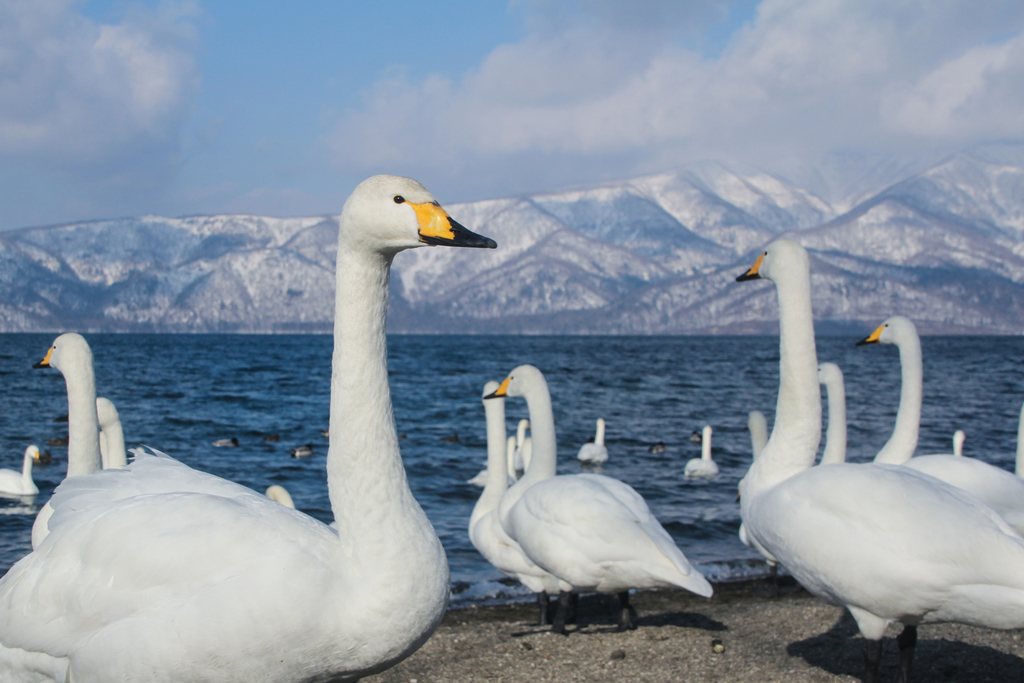
Photo: (c) Austin 0201, some rights reserved (CC BY) · CC-BY (May be cropped or resized)
Cygnus cygnus
Rare visitor: recorded only occasionally in this country
Basic stats
Diet
Aquatic plants, roots and grasses
Habitat
Lakes, rivers, marshes and farmland
Clutch size
4–6 eggs
Size
140–165cm
Wingspan
205–275cm
The Whooper Swan is a very large white waterbird with a long, straight neck and a wedge-shaped yellow-and-black bill. The yellow patch extends forward in a pointed shape, distinguishing it from the smaller Tundra Swan's usually shorter yellow area. Adults are entirely white, whereas juveniles are grey-brown with pinkish bills. Its deep, resonant bugling calls carry far across open wetlands (Wikipedia, general species account).
Whooper Swans feed by dipping and upending for aquatic vegetation, roots and tubers, and also graze on grass or waste grain in fields. Pairs build a large mound nest beside shallow water and often remain together for years. Northern breeders migrate in family groups to ice-free wintering grounds; in Japan they gather on lakes, rivers, marshes and agricultural land, especially in northern regions (Wikipedia, general species account).
Quick answers
- What does the Whooper Swan eat?
- Aquatic plants, roots and grasses
- What habitat does the Whooper Swan live in?
- Lakes, rivers, marshes and farmland
- How many eggs does the Whooper Swan lay?
- 4–6 eggs
- How big is the Whooper Swan?
- 140–165cm
- What is the wingspan of the Whooper Swan?
- 205–275cm
In Japan
GBIF holds 1,412 records of the Whooper Swan from 8 protected areas in Japan, dated 1978 to 2026. Most come from Nemuro Peninsula & Lake Furen and Abashiri Quasi National Park.
Where it has been recorded
- Nemuro Peninsula & Lake Furen 657 records, latest 2026
- Abashiri Quasi National Park 313 records, latest 2024
- Lake Utonai 195 records, latest 2024
- Lake Tofutsu 186 records, latest 2024
- Onuma Quasi-National Park 32 records, latest 2024
- Lake Kutcharo 15 records, latest 2024
- Fuji-Hakone-Izu National Park 8 records, latest 2020
- Shiretoko Peninsula 6 records, latest 2024
Covered in our place guides: Nemuro Peninsula & Lake Furen, Shiretoko Peninsula.
Seen on trips we host
- Winter Birding on Ice (Charley Hesse) Tropical Birding, 2012
- Winter Birding on Ice (Keith Barnes) Tropical Birding, 2013
- Winter Birding on Ice (Charley Hesse) Tropical Birding, 2014
- Winter Birding on Ice (Charley Hesse) Tropical Birding, 2015
Also in our other guides: Korea.
Records: GBIF occurrence data matched to park boundaries (© OpenStreetMap contributors, ODbL; Wikidata). Counts show recording effort, not how common the species is.