
 Wildlife
of Japan
Mandarin Duck
Ducks, Geese & Grebes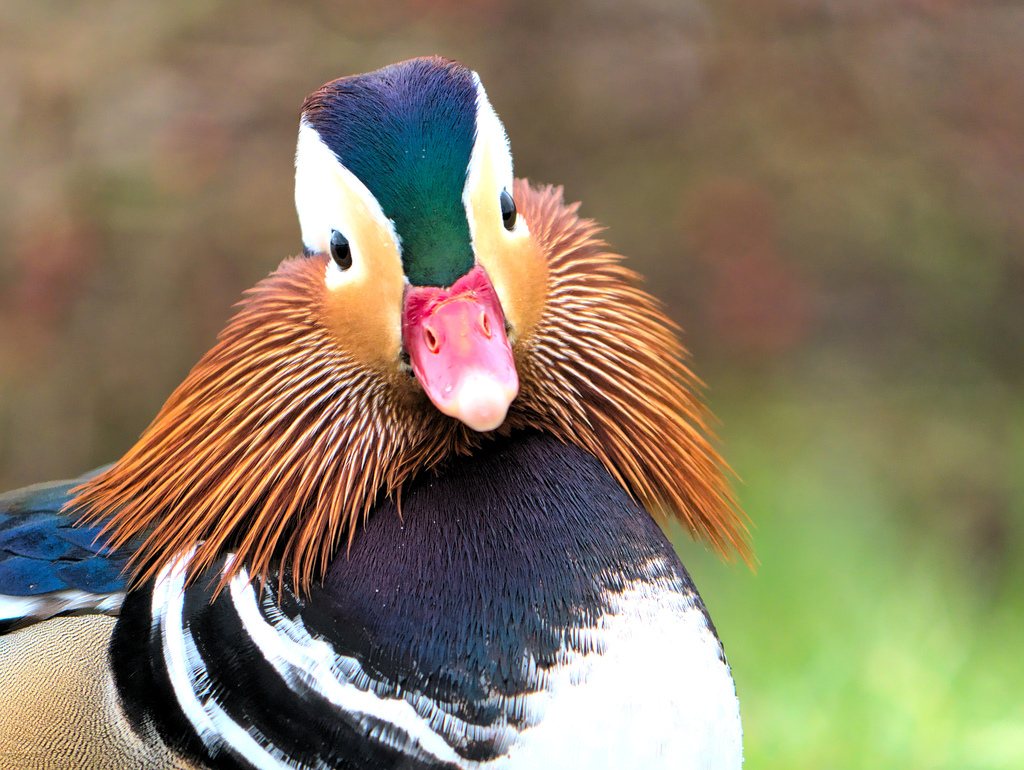
Photo: (c) Blake Ross, some rights reserved (CC BY) · CC-BY (May be cropped or resized)
Aix galericulata
Rare visitor: recorded only occasionally in this country
Basic stats
Diet
Seeds, acorns, aquatic plants and invertebrates
Habitat
Wooded lakes, ponds and rivers
Clutch size
9–12 eggs
Size
41–49cm
The male Mandarin Duck is among the most ornate waterfowl, with orange sail-shaped wing feathers, a broad white eye stripe, reddish bill and a mixture of green, purple, chestnut and cream plumage. Females are grey-brown with a white eye ring and trailing stripe. Both sexes are compact, long-tailed perching ducks with strong claws suited to resting on branches (Wikipedia, general species account).
Mandarin Ducks favour wooded lakes, ponds and slow rivers. They dabble for seeds and aquatic plants, forage ashore for acorns, and take invertebrates seasonally. The female nests in a tree cavity, sometimes well above the ground; newly hatched ducklings leap down and follow her to water. Native across eastern Asia, the species is resident or locally migratory in Japan and also has introduced populations elsewhere (Wikipedia, general species account).
Quick answers
- What does the Mandarin Duck eat?
- Seeds, acorns, aquatic plants and invertebrates
- What habitat does the Mandarin Duck live in?
- Wooded lakes, ponds and rivers
- How many eggs does the Mandarin Duck lay?
- 9–12 eggs
- How big is the Mandarin Duck?
- 41–49cm
In Japan
GBIF holds 192 records of the Mandarin Duck from 12 protected areas in Japan, dated 1984 to 2026. Most come from Biwako Quasi-National Park and Shiretoko Peninsula.
Where it has been recorded
- Biwako Quasi-National Park 42 records, latest 2024
- Shiretoko Peninsula 36 records, latest 2026
- Fuji-Hakone-Izu National Park 23 records, latest 2023
- Onuma Quasi-National Park 20 records, latest 2024
- Yanbaru, Northern Okinawa 16 records, latest 2024
- Unzen-Amakusa National Park 16 records, latest 2023
- Aso-Kuju National Park 11 records, latest 2014
- Abashiri Quasi National Park 10 records, latest 2024
Plus 4 more sites.
Covered in our place guides: Shiretoko Peninsula, Yanbaru, Northern Okinawa, Nemuro Peninsula & Lake Furen.
Seen on trips we host
- Winter Birding on Ice (Charley Hesse) Tropical Birding, 2012
- Winter Birding on Ice (Keith Barnes) Tropical Birding, 2013
- Winter Birding on Ice (Charley Hesse) Tropical Birding, 2015
- Winter Birding on Ice (Charley Hesse and Sam Woods) Tropical Birding, 2016
Also in our other guides: Korea.
Records: GBIF occurrence data matched to park boundaries (© OpenStreetMap contributors, ODbL; Wikidata). Counts show recording effort, not how common the species is.