
 Wildlife
of Japan
Smew
Ducks, Geese & Grebes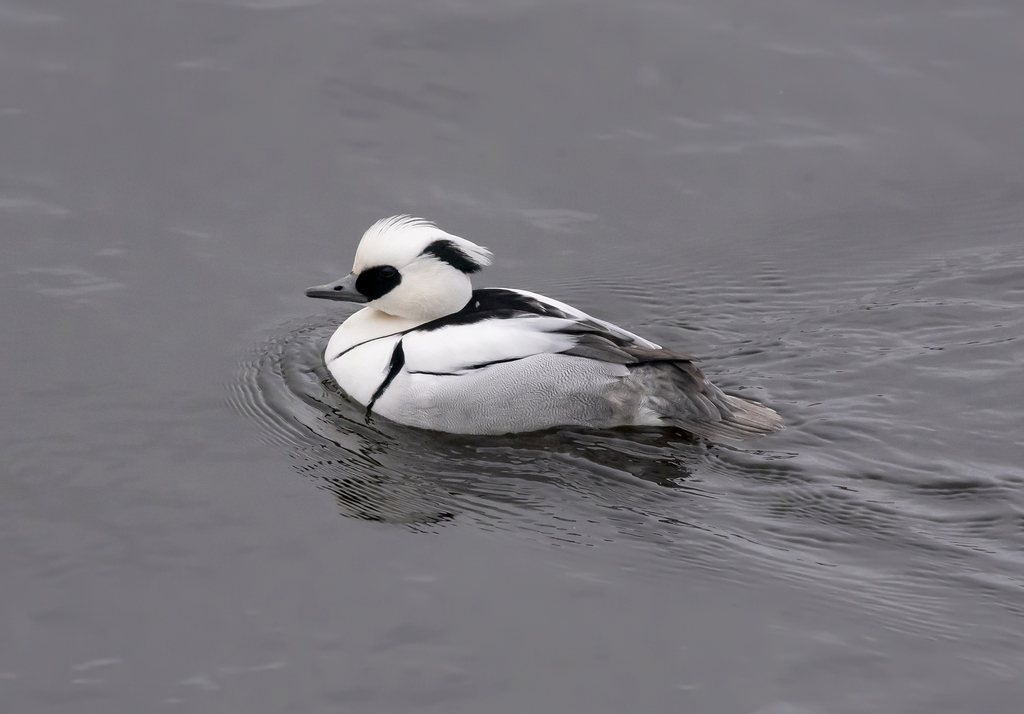
Photo: (c) Griha Hasanov, some rights reserved (CC BY) · CC-BY (May be cropped or resized)
Mergellus albellus
Rare visitor: recorded only occasionally in this country
Basic stats
Diet
Small fish and aquatic invertebrates
Habitat
Forested lakes, rivers and sheltered winter waters
Size
38–44cm
The Smew is a small merganser with sharply contrasting plumage. Adult males are mostly white, crossed by fine black lines around the eye, back and breast, producing a cracked-ice pattern. Females and immature birds have grey bodies, chestnut crowns and cheeks, and a clean white throat; this distinctive plumage is often called redhead. The short, hooked bill remains adapted for catching slippery prey (Wikipedia, general species account).
Smews breed beside northern forest lakes and slow rivers, nesting in tree cavities, especially old woodpecker holes. They dive for small fish, insect larvae and crustaceans, and frequently feed in loose groups. After breeding they migrate to unfrozen lakes, reservoirs, rivers and sheltered coastal water. Japan lies within the East Asian winter range, where the species is usually seen singly or in small parties (Wikipedia, general species account).
Quick answers
- What does the Smew eat?
- Small fish and aquatic invertebrates
- What habitat does the Smew live in?
- Forested lakes, rivers and sheltered winter waters
- How big is the Smew?
- 38–44cm
In Japan
GBIF holds 420 records of the Smew from 7 protected areas in Japan, dated 1978 to 2026. Most come from Biwako Quasi-National Park and Nemuro Peninsula & Lake Furen.
Where it has been recorded
- Biwako Quasi-National Park 121 records, latest 2024
- Nemuro Peninsula & Lake Furen 94 records, latest 2026
- Fuji-Hakone-Izu National Park 76 records, latest 2026
- Abashiri Quasi National Park 48 records, latest 2024
- Lake Tofutsu 38 records, latest 2024
- Lake Utonai 22 records, latest 2024
- Onuma Quasi-National Park 21 records, latest 2022
Covered in our place guides: Nemuro Peninsula & Lake Furen.
Seen on trips we host
- Winter Birding on Ice (Keith Barnes) Tropical Birding, 2013
- Winter Birding on Ice (Charley Hesse) Tropical Birding, 2018
- Winter Birding on Ice Custom Tour (Andres Vasquez) Tropical Birding, 2018
- Winter Birding on Ice, part 2 (Charley Hesse) Tropical Birding, 2019
Also in our other guides: Korea.
Records: GBIF occurrence data matched to park boundaries (© OpenStreetMap contributors, ODbL; Wikidata). Counts show recording effort, not how common the species is.