
 Wildlife
of Japan
Indian Spot-billed Duck
Ducks, Geese & Grebes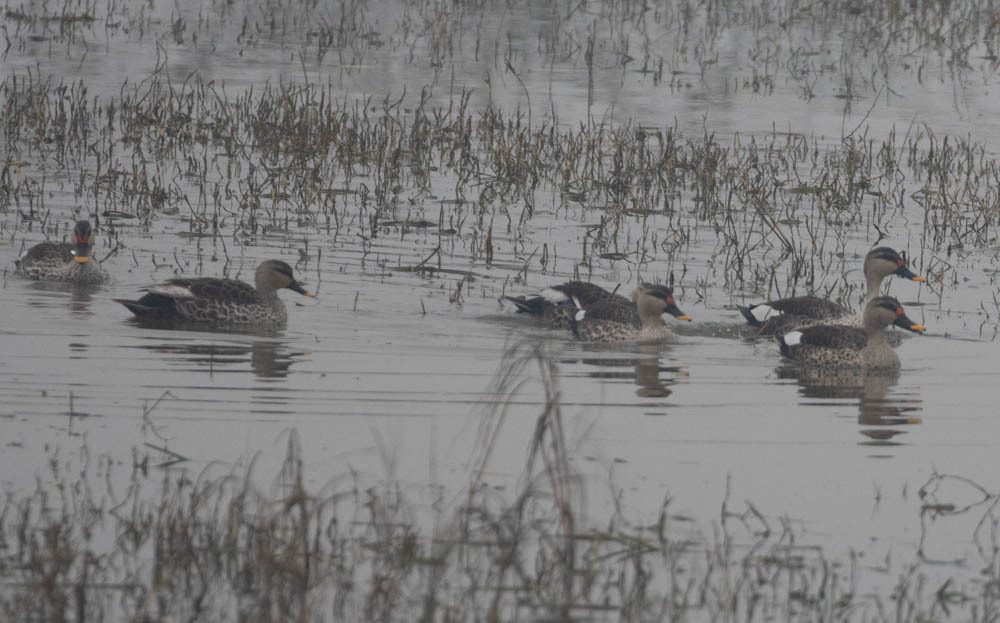
Photo: avocat · CC BY 4.0 (May be cropped or resized)
Anas poecilorhyncha
Rare visitor: recorded only occasionally in this country
Basic stats
Diet
Aquatic plants, seeds and invertebrates
Habitat
Freshwater lakes, marshes and rivers
Clutch size
8–14 eggs
The Indian Spot-billed Duck is a large, mainly grey-brown dabbling duck with a scaly body pattern, pale head, dark cap and eye stripe. Its black bill ends in a conspicuous yellow tip and carries red spots at the base in adults. A green wing speculum bordered by white flashes in flight. Male and female plumages are similar, although their voices differ (Wikipedia, general species account).
This species uses freshwater lakes, marshes, rivers and flooded cultivation across South Asia, feeding by dabbling for aquatic vegetation, seeds and invertebrates. It is generally resident rather than strongly migratory and often occurs in pairs or small groups. The nest is placed in vegetation near water, and the female incubates the eggs. Japanese observations fall well beyond its core range and are treated as unusual occurrences (Wikipedia, general species account; Wildlife of Japan occurrence records).
Quick answers
- What does the Indian Spot-billed Duck eat?
- Aquatic plants, seeds and invertebrates
- What habitat does the Indian Spot-billed Duck live in?
- Freshwater lakes, marshes and rivers
- How many eggs does the Indian Spot-billed Duck lay?
- 8–14 eggs
In Japan
GBIF holds 542 records of the Indian Spot-billed Duck from 9 protected areas in Japan, dated 1962 to 2014. Most come from Biwako Quasi-National Park and Fuji-Hakone-Izu National Park.
Where it has been recorded
- Biwako Quasi-National Park 234 records, latest 2014
- Fuji-Hakone-Izu National Park 116 records, latest 2014
- Iriomote Island 66 records, latest 2014
- Kirishima-Kinkowan National Park 55 records, latest 2014
- Unzen-Amakusa National Park 44 records, latest 2014
- Yanbaru, Northern Okinawa 14 records, latest 2014
- Aso-Kuju National Park 5 records, latest 2008
- Higashiyoka-higata 5 records, latest 2006
Plus 1 more sites.
Covered in our place guides: Iriomote Island, Yanbaru, Northern Okinawa.
Also in our other guides: Korea.
Records: GBIF occurrence data matched to park boundaries (© OpenStreetMap contributors, ODbL; Wikidata). Counts show recording effort, not how common the species is.