
 Wildlife
of Japan
Eurasian Teal
Ducks, Geese & Grebes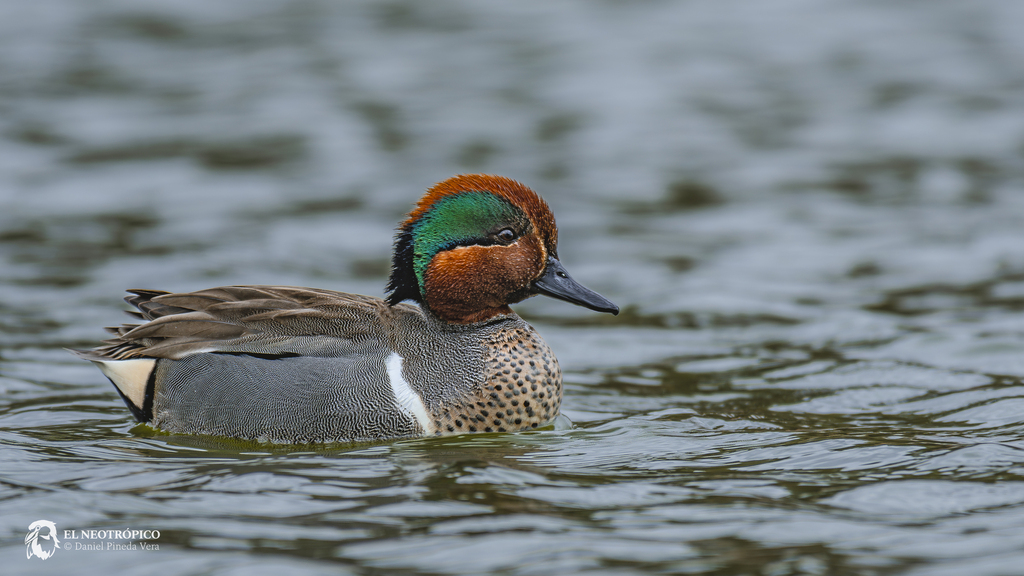
Photo: (c) Daniel Pineda Vera, some rights reserved (CC BY) · CC BY 4.0 (May be cropped or resized)
Anas crecca
Rare visitor: recorded only occasionally in this country
Basic stats
Diet
Seeds and aquatic invertebrates
Habitat
Shallow marshes, ponds, lakes and estuaries
Clutch size
8–11 eggs
Size
34–43cm
The Eurasian Teal is a very small dabbling duck with narrow wings and quick, agile flight. Breeding males have a chestnut head crossed by a broad green eye patch, a finely patterned grey body and a cream stripe beside the tail. Females are mottled brown but show a glossy green wing speculum. Outside breeding plumage, males resemble females but retain a darker bill (Wikipedia, general species account).
Eurasian Teal favour shallow marshes, ponds, lake margins and sheltered estuaries. They feed mainly at the surface, dabbling for seeds and aquatic invertebrates, often becoming most active around dusk or at night. Dense waterside vegetation shelters the ground nest. Many populations migrate long distances between northern breeding areas and milder winter wetlands, when large, tightly packed flocks can form (Wikipedia, general species account).
Quick answers
- What does the Eurasian Teal eat?
- Seeds and aquatic invertebrates
- What habitat does the Eurasian Teal live in?
- Shallow marshes, ponds, lakes and estuaries
- How many eggs does the Eurasian Teal lay?
- 8–11 eggs
- How big is the Eurasian Teal?
- 34–43cm
In Japan
GBIF holds 1,450 records of the Eurasian Teal from 19 protected areas in Japan, dated 1982 to 2026. Most come from Biwako Quasi-National Park and Fuji-Hakone-Izu National Park.
Where it has been recorded
- Biwako Quasi-National Park 369 records, latest 2024
- Fuji-Hakone-Izu National Park 214 records, latest 2024
- Nemuro Peninsula & Lake Furen 184 records, latest 2026
- Abashiri Quasi National Park 144 records, latest 2024
- Higashiyoka-higata 97 records, latest 2024
- Aso-Kuju National Park 72 records, latest 2026
- Lake Tofutsu 70 records, latest 2024
- Kirishima-Kinkowan National Park 51 records, latest 2023
Plus 11 more sites.
Covered in our place guides: Nemuro Peninsula & Lake Furen, Iriomote Island, Yanbaru, Northern Okinawa.
Seen on trips we host
- Winter Birding on Ice (Keith Barnes) Tropical Birding, 2013
- Winter Birding on Ice (Charley Hesse) Tropical Birding, 2015
- Winter Birding on Ice (Charley Hesse and Sam Woods) Tropical Birding, 2016
- Winter Birding on Ice (Charley Hesse) Tropical Birding, 2018
Also in our other guides: Korea.
Records: GBIF occurrence data matched to park boundaries (© OpenStreetMap contributors, ODbL; Wikidata). Counts show recording effort, not how common the species is.